Investment Insights
2026 Investment Markets Outlook
Last Updated: 30 Jan 26 5 min read
From the M&G Life Investment Office (LIO). The team of in-house specialists responsible for designing and managing a range of M&G's multi-asset funds.
2025 Equity total returns in Sterling
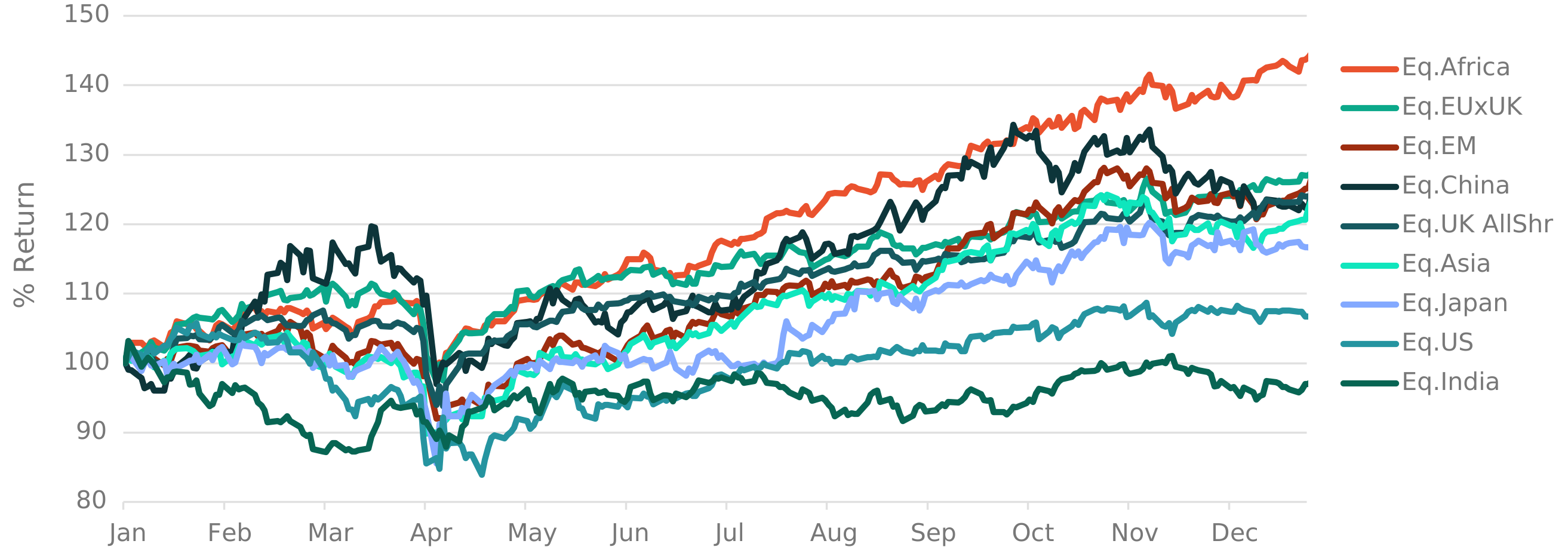
[Source: Datastream. Chart shows unhedged total returns in sterling terms, rebased to 100 at the beginning of 2025. Regional performance is represented by the following benchmarks: FTSE UK All Share, FTSE W Europe, US equities represented by a composite of S&P 500 and S&P 500 (EW), S&P Topix 150, FTSE W Asia Pacific Ex Japan, MSCI China, FTSE India, MSCI EM, with Africa represented by a composite of FTSE/JSE Capped All Share & MSCI FM Africa Ex South Africa. Daily data covering the full 2025 calendar year.]
Reflections on 2025
2025 proved to be a strong year for markets amidst uncertainty, as many asset classes delivered returns that far exceeded their long-term historical averages. This period stands out not only for the magnitude of the gains, but also for the pronounced differences in performance observed across various regions - the most notable dispersion since 2009. Unsurprisingly the journey itself was interesting. The critical drawdown periods were linked to US mega cap names coming under pressure from Chinese competition, and the actions of the new Trump administrations protectionist shift in trade policy. The release of the AI platform DeepSeek sent shockwaves through the industry, demonstrating how close the Chinese tech sector is to the technological frontier - and doing so at a fraction of the cost, using a collection of supposedly inferior chips.
The market reaction to the ‘Liberation Day’ announcement on the 2nd April 2025 was sharp but short-lived, as a series of policy U-turns from the Trump administration quickly followed. Within equities, the US market experienced the largest drawdown, with the S&P 500 declining by nearly 18% in GBP terms. This episode also prompted a reassessment of how a more hawkish trade stance might affect US assets. As the narrative of US exceptionalism was challenged, 2025 saw a rotation out of US assets unfold over the year. Naturally this has led us to reflect on valuations – a theme explored in Section 1.
Talking points for 2026
As we move into a new year, we consider some key questions and talking points:
(1) Valuations: What’s the message for markets?
Markets had a strong 2025, but much of the gains came from higher prices rather than improving fundamentals, suggesting more modest returns ahead. While positive momentum can continue for a while, expensive markets often lead to lower returns over the medium-term. It’s sensible to stay cautious given ongoing global uncertainties.
Valuations remain central to our thinking: higher yields support bonds, but fading rate tailwinds and tight credit spreads limit upside, while expensive equities typically imply softer long-term returns. With our outlook slightly softer but still aligned to long-term averages, the priority is to stay diversified across regions and asset classes and avoid over-concentration in areas that look expensive, as fundamentals – not short-term momentum – will ultimately drive performance.
(2) Technology: Is AI still powering markets?
Artificial Intelligence (AI) accelerated sharply in 2025, led by Hyperscalers and Nvidia, boosting productivity expectations and supporting equity valuations. But questions over energy capacity, regulation and US-China tensions highlight that the pace of adoption may not be sustainable.
AI has made tech companies far more capital-intensive, and valuations now rely on continued rapid uptake across the ecosystem. Any slowdown could trigger a sharp repricing, affecting both public and private markets. While long-term productivity gains remain compelling, the investment required highlights both opportunity and risk, particularly around power and cooling capacity.
We remain positive on AI’s long-term potential but are mindful of near-term pressures. Our portfolios maintain technology exposure while avoiding excessive concentration in US mega-caps. The aggregate exposure is in a similar ball park to peers, but we are significantly less concentrated in US Tech with a more diversified approach across regions such as China, Taiwan and South Korea.
(3) Dollar Weakness: What happened and why it matters
The US dollar had its weakest year since 2017, falling nearly 10% in 2025 driven by tariff uncertainty, Federal Reserve political pressures and a prolonged government shutdown.
A softer dollar boosted emerging-markets assets, with Emerging Market equities and bonds delivering strong USD-based gains, while commodity producers benefited from supportive pricing. Currency cycles tend to be long-lasting, and structural factors such as fiscal concerns and reserve diversification suggest weakness could extend into 2026.
For investors, this environment reinforces the value of global diversification. Emerging Market exposures have been rewarded, though a weaker dollar also raises US inflation risks and could add policy-driven volatility ahead.
(4) Inflation Risk: Why it’s back on the radar
Inflation pressures persist. A more accommodative 2026 backdrop and new spending stimulus support markets - but risk fuelling prices. US and UK inflation remains sticky, slowing rate-cut plans versus Europe. Further Fed easing is possible, but rising debt and borrowing costs complicate inflation control.
Tariffs, a weaker dollar and supply constraints add to price pressures, keeping US inflation risks elevated despite weaker growth. Inflation will stay a key driver of policy and market volatility.
Investment implications
In recent years, the landscape of economic and capital market cycles has experienced notable changes, and in particular the movement away from an extended period of near zero interest rates towards a more 'normalised' interest rate environment.
The move away from historically low rates created distinct challenges for public markets, particularly in 2022, as investors and institutions adapted to the new dynamics. Subsequently, private markets have also experienced notable pain points, with the impact becoming especially pronounced from 2023 through to 2025.
What does this all mean for investors?
As we enter 2026, whilst much of the impact of this adjustment to the interest rate environment appears to have been absorbed, we see a few key takeaways for investors.
- Valuation aware - avoid concentration in expensive markets or single themes, and over the medium-term fundamentals will matter more than short-term momentum.
- Multi-Layered diversification - Diversification remains a core tenet, and this cuts across different regions, asset classes and also sectoral mixes. For example, whilst there is no ignoring the strength of US technology companies in recent years, however, there are companies in other parts of the world in the technology stack that also offer high growth but at a lower price per unit of expected growth and so we see benefit in maintaining that balance.
- Add resilience - consider strategies and assets that provide exposure to independent sources of returns, which would do well in environments where traditional asset classes struggle. Safe haven assets are important but even within developed market government bonds it will be important to be diversified.
Our range of funds offer globally diversified portfolios, well placed to capture reward and manage risk for your clients in 2026.
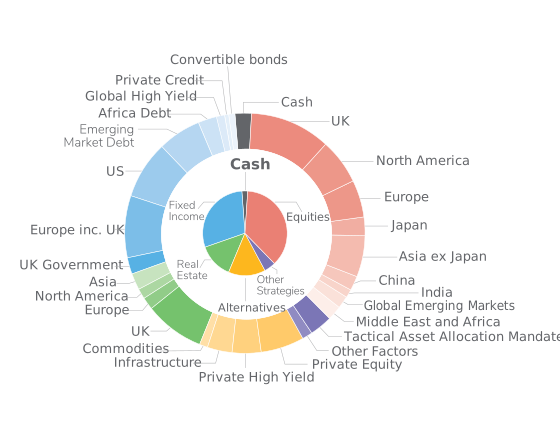
[Source: Long-Term Investment Strategy Team, M&G Life Investment Office – PruFund Growth Fund 2025 Strategic Asset Allocation]
Asset Class Views
Developed markets:
2025 delivered strong double-digit returns across major indices, but elevated US valuations – driven by AI enthusiasm and ample liquidity – heighten risk, especially with potential growth shocks or policy missteps.
Emerging markets:
Stronger relative growth, widening valuation discounts and potentially weaker dollar support emerging market prospects for 2026, though tariff risks and trade tensions remain key watchpoints.
Government Bonds:
Government bonds delivered solid returns in 2025, thanks to high starting yields and steadier rate expectations. In 2026, policy rates, are set to converge, with the US and UK easing, Japan tightening gradually, and Europe remaining relatively stable. Yield curves have steepened as term premia normalise, and while positive real yields improve return prospects, inflation and fiscal risks could still drive volatility. Overall, government bonds now offer better value and useful diversification, but a mix of regions and maturities remain important.
Corporate Bonds:
Corporate bond yields edged lower in 2025 as rates fell and spreads tightened, led by the U.S. dollar market, while European investment grade finished broadly unchanged. In the U.S. companies with strong fundamentals should be able to maintain healthy margins, supported by AI-driven efficiencies and reduced leverage, with debt servicing costs now easing.
Defaults are expected to stay contained into 2026, but risks remain. Ultra-tight spreads, slowing growth, tricky monetary policy decisions and external pressures such as tariff uncertainty could still challenge credit markets.
Commercial real estate enters 2026 still regaining ground after higher interest rates, with 2025 delivering steady but muted returns versus public markets. Rental growth is emerging in select areas – especially in Europe – though analysts expect performance to diverge widely across sectors and locations.
The return outlook for 2026 is cautiously positive, supported by normalising vacancy rates, limited new supply, stable demand and broadly attractive valuations. While a strong rally is unlikely, sentiment is improving in the US, strengthening in Europe’s peripheral markets and remains upbeat in Japan and India.
Alternatives
Private equity endured another stop-start year in 2025, with early momentum stalling amid tariff uncertainty and a quiet summer before activity improved in the second half. The key question for 2026 is whether deal flow can truly accelerate or if “extend and pretend” will continue to dominate.
Although 2025 felt like a holding pattern, structural shifts are underway within the industry. The asset class has a strong long-term record of delivering an illiquidity premium, but recent years have tested investor patience. The coming year should offer clearer signals on when that patience will finally be rewarded.
Private credit - lending outside traditional banks – has grown rapidly since the financial crisis, offering attractive returns and diversification. But 2025 highlighted risks, with a few failures highlighting concerns around lending standards, even as overall default rates remain low.
Strong demand and ample capital continue to support the sector, though increased competition has tightened terms, and added risk to some loans. For investors, manager discipline is essential: selecting lenders who maintain rigorous standards rather than chasing yield.
Private Credit can add income and diversification, but it’s not without risk. Careful selection and a focus on quality lending are essential to avoid surprises if markets turn.
Infrastructure remains a major long-term theme. Although activity has been quieter since the 2021-2022 boom, momentum is improving as economies invest in AI buildout, urbanisation, energy transition and climate resilience.
For investors, infrastructure continues to offer stable, inflation-linked cash flows, but stretched public finances mean private capital will play an even larger role. Selectivity is crucial: core assets face return compression, so focusing on strong fundamentals and avoiding political or technological risks is key.
Looking ahead, the outlook is positive. Many of the structural trends shaping the global economy will require significant upgrades to existing infrastructure and substantial new investment.
Traditional markets are driven largely by macro forces like rates and growth, leaving returns closely tied to the economic cycle. To improve diversification, we’re adding “orthogonal” return sources such as cross asset momentum and volatility risk premium, which behave differently from equities and bonds.
These strategies have historically shown low correlation with traditional assets, helping portfolios stay more resilient during periods of stress. Even small allocations can enhance risk-adjusted returns, reducing reliance on macro conditions and adding an extra layer of protection when volatility spikes.
This content has been prepared by M&G Life Investment Office (LIO) for information purposes only and does not contain or constitute investment advice. Information provided herein has been obtained from sources that LIO believes to be reliable and accurate at the time of issue but no representation or warranty is made as to its fairness, accuracy, or completeness. The views expressed herein are subject to change without notice. Neither LIO, nor any of its associates, nor any director, or employee accepts any liability for any loss arising directly or indirectly from any use of this document. The value of investments and any income from them may go down as well as up and are not guaranteed. Investors may get back less than the original amount invested and past performance information is not a guide to future performance.
‘M&G Life Investment Office (LIO)’ includes the team formerly known as Prudential Portfolio Management Group (PPMG), Prudential Portfolio Management Group Limited, is registered in England and Wales, registered number 2448335.
The Long Term Investment Strategy team, part of the Investment Office at M&G Plc, sets the Strategic Asset Allocation for internal client savings and investment products as well as providing various economic scenarios and modelling for M&G Plc. As part of this, we regularly review our asset class views and their sensitivity to economic and capital market developments, the philosophy and framework. This publication presents our outlook over the medium term and touches on some of the major themes that are currently influencing our asset allocation thinking.